Instrumentation Guide · Pressure Measurement
Diaphragm Seal Pressure Gauge Selection Guide: Baumer vs WIKA
Everything you need to specify the right diaphragm seal pressure gauge — working principle, diaphragm materials, fill fluid selection, 17+ industry applications, and a detailed Baumer vs WIKA comparison.
Why This Decision Is More Than a Catalogue Lookup
When the process fluid is aggressive, viscous, crystallizing, or must stay sterile, a standard Bourdon tube gauge will fail, clog, or contaminate within days. A diaphragm seal pressure gauge solves this with one design principle: a flexible membrane that keeps the measuring instrument permanently isolated from the process.
This guide covers every selection parameter — from diaphragm material and fill fluid to process connection and accuracy class — and provides a detailed, factual comparison between two of the most trusted brands in the market: WIKA and Baumer. Whether you are specifying for a pharmaceutical CIP line, a chlorine dosing system, a dairy process, or an oil refinery, this handbook gives you the engineering depth to get the specification right the first time.
What Is a Diaphragm Seal Pressure Gauge?
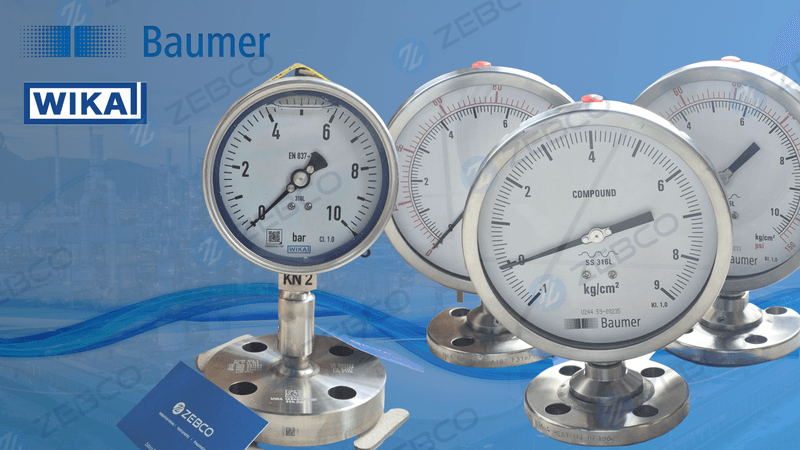
A diaphragm seal pressure gauge is a pressure measurement assembly in which a flexible membrane physically separates the process fluid from the gauge internals — transmitting pressure through a captive fill fluid without any process contact with the gauge.
In a standard Bourdon tube gauge, process fluid enters directly into the gauge socket. That works fine for clean, non-corrosive, low-viscosity media. But the moment the process fluid is corrosive, sticky, sterile, or particulate-laden, direct gauge contact is either destructive or simply not permitted.
A diaphragm seal adds three components between the process and the gauge:
- The diaphragm — a thin, corrugated or flat flexible membrane (SS316L, Hastelloy, PTFE-lined, Tantalum, etc.) that deflects proportional to the applied pressure
- The fill fluid — an incompressible liquid (silicone oil, FDA white oil, glycerin, halocarbon) filling the sealed cavity between diaphragm and gauge
- The seal housing / body — the pressure vessel that contains the fill fluid and provides the process connection
Engineering Principle: Because liquids are incompressible, pressure applied to the diaphragm transmits through the fill fluid to the gauge's Bourdon tube with near-zero loss, exactly as Pascal's Law describes. The gauge reads the process pressure faithfully without the process medium ever touching it.
Cross-Section — How To Visualize It
From process connection at the bottom to gauge dial at the top:
- Bottom — process pipe flange or threaded connection, with process fluid below the diaphragm
- Diaphragm — corrugated flexible membrane (0.1–0.3 mm thick), welded or clamped into the seal body
- Fill fluid cavity — sealed space above the diaphragm, filled with silicone oil or equivalent
- Capillary (remote seal only) — thin-wall SS tube (typically 1.5 mm ID) carrying fill fluid to the remote gauge
- Gauge top — Bourdon tube gauge connected directly to the fill fluid path, with the pointer responding to process pressure
Diaphragm Thickness
0.1–0.3 mm, corrugated profile for high sensitivity at low pressure ranges
Fill Fluid Volume
2–15 ml, depending on seal size and capillary length
Accuracy Class
±0.5–2.5% full scale per EN 837
Temperature Range
-60°C to +400°C, depending on fill fluid and seal design
Practical Min. Span
~400 mbar; below this, diaphragm stiffness dominates error
Max. Pressure
Up to 1,600 bar on cell-type high-pressure designs
Why Use a Diaphragm Seal?
Diaphragm seals are not a premium upgrade — they are the technically correct solution whenever the process fluid must not contact the gauge internals.
Corrosive Media
Acids (HCl, H₂SO₄, HNO₃), alkalis (NaOH, KOH), chlorine, bromine, and oxidising chemicals attack standard brass or even SS316 Bourdon tubes within weeks at elevated temperatures. A Hastelloy C-276 or Tantalum diaphragm survives where standard gauge materials cannot.
A chlorine dosing pump in a water treatment plant corroded through two standard SS316 gauges in three months. Switching to a PTFE-lined diaphragm seal gauge with halocarbon fill fluid eliminated all corrosion failures for over four years of continuous service.
Viscous Fluids
Polymer melts, resins, heavy crude oil, bitumen, and adhesives clog a standard gauge port immediately. A flush-face diaphragm seal presents a smooth, unobstructed face that viscous media flows past without restriction.
Crystallising Liquids
NaOH solutions, sugar syrups, sodium chloride brines, and many pharmaceutical compounds crystallise inside a gauge tube when they cool, blocking the port and destroying the Bourdon tube. A diaphragm seal keeps these fluids entirely outside the gauge.
Slurries and Particulate Media
Mining slurries, paper pulp, ceramic slips, cement, and sewage sludge carry abrasive particles that scour gauge internals rapidly. A flush diaphragm has no crevice or dead volume for particles to accumulate.
Hygienic and Food-Grade Applications
In dairy, beverage, pharmaceutical, and biotech processes, the gauge must be cleanable-in-place (CIP), sterilisable-in-place (SIP), and must not harbour bacteria. Sanitary diaphragm seals with Ra ≤ 0.8 µm surface finish and tri-clamp connections meet 3-A, FDA, and EHEDG requirements.
High Process Temperature
Process temperatures above 100°C can damage gauge fill fluids. A capillary remote seal with a cooling leg allows the gauge to operate at ambient temperature while measuring 300°C steam or hot thermal oil.
High Vibration Environments
Compressor skids and reciprocating pump stations subject gauges to destructive pulsation. A glycerin-filled gauge with a diaphragm seal provides double damping, protecting the Bourdon tube from vibration fatigue.
Toxic, Sterile, and High-Purity Media
Any process where the medium must never enter the gauge, due to toxicity, sterility, or purity requirements, mandates a diaphragm seal. This includes ammonia, H₂S, HF vapour, toxic solvents, sterile pharmaceutical media, and semiconductor-grade gases.
Industry Applications
Diaphragm seal pressure gauges are used across virtually every process industry. The table below gives recommended specifications for the most common applications.
Not sure which diaphragm seal gauge fits your exact process conditions?
Share your process fluid, pressure range, and temperature — our engineering team will recommend the correct diaphragm material, fill fluid, and process connection.
How Does a Diaphragm Seal Work?
The working principle is straightforward: a flexible membrane deflects under process pressure, compressing an incompressible fill fluid, which transmits that pressure faithfully to the gauge sensing element.
Pressure Transmission — Step by Step
- Process pressure acts on the diaphragm face — the process medium pushes against the lower, wetted face of the diaphragm
- Diaphragm deflects — the corrugated or flat membrane flexes proportional to applied pressure, within its elastic range
- Fill fluid is compressed — the deflection reduces the fill cavity volume, raising pressure in the incompressible fill fluid
- Pressure propagates via Pascal's Law — pressure in an enclosed fluid transmits equally in all directions to all surfaces, instantaneously
- Bourdon tube responds — the gauge Bourdon tube receives the identical pressure and deflects, driving the pointer to the correct reading
Temperature Influence — The Key Limitation
Fill fluid expands with temperature. When process or ambient temperature changes, the fill volume changes, and the gauge interprets this volume change as a pressure change — creating a temperature-induced zero error. This is the primary source of inaccuracy in diaphragm seal systems.
Critical Design Point
A silicone oil fill with a thermal expansion coefficient of roughly 0.001/°C in a typical seal with 10 ml fill volume can create a spurious pressure reading of approximately 0.1–0.3 bar per 10°C temperature change, depending on seal volume and gauge full-scale range. For low-range gauges (0–4 bar or less) with long capillaries, always request the temperature error calculation from your supplier before ordering.
Response Time
Diaphragm seal gauges respond slightly more slowly than direct-connect gauges. Direct-mount seals typically respond in under 1 second. Capillary remote seals with 1–5 m capillary can have response times of 2–10 seconds — acceptable for process monitoring but not for fast-acting safety systems or pressure switches.
Types of Diaphragm Seals
Engineer Tip — Hygienic Surface Finish
For hygienic applications, always specify the Ra surface roughness value explicitly in your purchase order. "Sanitary" is not a precise term. 3-A Sanitary Standards require Ra ≤ 0.8 µm, EHEDG typically requires Ra ≤ 0.4 µm, and most pharmaceutical GMP specifications require Ra ≤ 0.25 µm. Ask for the surface finish measurement certificate from your supplier.
Selection Guide — Parameter by Parameter
Work through each parameter in sequence. Getting the specification right before you order prevents expensive failures in the field.
- Identify the process fluid — its chemical class, concentration, viscosity, particle content, and sanitary requirements. Corrosive acids or halogens point to Hastelloy C or Tantalum; food and pharma media point to polished SS316L with a sanitary connection and FDA-approved fill; viscous or slurry media point to a flush diaphragm; oxygen or oxidiser service always requires a halocarbon fill, never silicone.
- Determine the pressure range and type — gauge, absolute, vacuum, or compound — and set the full-scale range at 1.5–2× the maximum operating pressure.
- Define the process and ambient temperature range — below 100°C, standard silicone fill and a direct-mount seal are fine; 100–200°C calls for high-temperature silicone; above 200°C, a capillary remote seal with a cooling leg is mandatory.
- Check hygiene and regulatory requirements — food, pharma, or biotech applications mandate a tri-clamp, DIN 11851, or SMS connection with a specified Ra value and an FDA-approved fill fluid.
- Confirm hazardous area classification — Zone 1/2 or Zone 21/22 areas require ATEX-rated variants; this is not optional.
- Match the process connection — verify thread type, tri-clamp size, or flange rating against your existing nozzle or fitting.
- Select the accuracy class — Class 2.5 for utility monitoring, Class 1.6 for general process monitoring, and Class 1.0 or 0.5 for process control and safety-critical measurements.
- Choose dial size and mounting — 63 mm for close reading in limited space, 100 mm for a standard process gauge, 160 mm for panel mounting or distance reading, with bottom-mount or back-mount options as required.
- Confirm documentation requirements — calibration certificates, material test certificates (MTC), and hygienic design declarations should be confirmed at PO stage, not after delivery.
Important Note
Never select a diaphragm seal pressure gauge purely on pressure range and price. Wetted material compatibility and process connection mismatches are the two most common causes of premature instrument failure and unplanned downtime in Indian process plants.
Fill Fluid Selection Guide
Safety Warning — Oxygen Service
Never use silicone oil fill fluid in oxygen service. Silicone oil and oxygen under pressure can ignite explosively. Always specify halocarbon (CTFE) fill fluid for oxygen, chlorine, NF₃, and other strong oxidiser service, and ensure the complete gauge assembly is oxygen-cleaned and plugged before installation.
Process Connection Standards
- NPT (1/2", 3/4", 1") — North American tapered thread; pipe sealant required; not for CIP/SIP
- BSP / G (G1/2, G3/4, G1) — European parallel thread with O-ring face seal; widely used in India
- Tri-Clamp (ISO 2852) — hygienic clamp connection; standard for pharma, food, and biotech
- DIN 11851 — dairy/food threaded connection; German dairy industry standard
- SMS 1145 — Scandinavian dairy standard; common in Nordic food plant equipment
- ANSI 150/300/600 flange — North American flanged; suitable for large bore and high pressure
- DIN EN 1092-1 flange — European flanged standard (PN10 to PN400); most common in India
- JIS B2210 flange — Japanese standard; required for Japanese OEM equipment
How to Select the Correct Diaphragm Material
Baumer vs WIKA: Detailed Technical Comparison
Both Baumer and WIKA are European precision instrument manufacturers with decades of diaphragm seal experience. This comparison is factual, application-focused, and unbiased.
Side-by-Side Specification Comparison
Application-Specific Brand Recommendation
Zebco Engineering Recommendation
Neither WIKA nor Baumer is universally superior — they excel in different areas. WIKA wins on product breadth, global availability, and extreme pressure, temperature, and material capability. Baumer wins on hygienic design quality and digital integration for smart automation. For most Indian industrial and process applications, WIKA's broader availability gives it a practical procurement advantage. For GMP pharmaceutical, food, and biotech where hygienic engineering is the specification priority, Baumer is worth the additional sourcing effort. Zebco Engineering LLP supplies both brands across India with full technical selection support.
Common Selection Mistakes to Avoid
Mistake 1 — Silicone Oil in Oxygen Service
Silicone oil fill and oxygen under pressure is a fire/explosion hazard. Always specify halocarbon (CTFE) oil for oxygen, chlorine, NF₃, and strong oxidiser service. This is a safety-critical error with potentially fatal consequences.
Mistake 2 — SS316L for HCl Service
SS316L will corrode rapidly in HCl above 5% concentration and/or elevated temperature. The correct specification is Hastelloy C-276 or Tantalum. Always cross-reference your chemical against a material compatibility table at your actual concentration and temperature.
Mistake 3 — Ignoring Temperature-Induced Zero Error
Selecting a 0–4 bar gauge with a 5-metre capillary on a process varying 60°C in temperature can produce a thermal expansion error that is a significant fraction of full scale. Always request the temperature error calculation in writing from your supplier before ordering.
Mistake 4 — Wrong Gauge Pressure Range
Selecting a 0–100 bar gauge for a 5 bar process "for extra safety margin" puts the operating point in the lowest 5% of the range, where non-linearity and hysteresis are worst. Rule: gauge full scale should be 1.5–2× maximum operating pressure, with the pointer in the middle third of the dial under normal conditions.
Mistake 5 — Not Specifying Surface Finish for Hygienic Applications
Ordering a "sanitary" gauge without specifying Ra leaves too much room for interpretation. 3-A requires Ra ≤ 0.8 µm, EHEDG often requires Ra ≤ 0.4 µm, and many pharma specifications require Ra ≤ 0.25 µm. State Ra explicitly in your PO and request the surface finish certificate.
Mistake 6 — NPT Connection on a CIP/SIP Line
NPT threads create dead-legs that cannot be steam-sterilised and trap residue. All CIP/SIP pharmaceutical and food applications require tri-clamp (ISO 2852), DIN 11851, or SMS connections.
Mistake 7 — No Pulsation Protection on Pump Discharge
Even with a diaphragm seal, pump pulsation fatigue can damage the gauge Bourdon tube over time if installed directly on a reciprocating pump outlet without protection. Specify glycerin fill in the gauge and consider a pulsation damper or snubber in the gauge port.
Engineer's Selection Checklist
Work through every item below before raising a purchase order.
Process Fluid
- Process fluid identified — chemical name, concentration, phase (liquid / gas / slurry)
- Corrosion check complete — diaphragm and body material verified against chemical resistance data at actual concentration and temperature
- Viscosity and particle content noted — flush diaphragm specified for viscous or particulate media
- Crystallisation risk assessed — heating jacket or flush diaphragm specified if applicable
- Hygienic requirements confirmed — Ra value, connection type, 3-A / EHEDG / FDA compliance stated if food or pharma
Pressure and Temperature
- Min / max process pressure stated — gauge full scale set at 1.5–2× maximum operating pressure
- Vacuum or compound range needed — compound gauge specified if pressure goes below atmospheric
- Process temperature stated — fill fluid and seal type verified for this temperature range
- Ambient temperature range noted — especially for outdoor installations and capillary remote seals
- Temperature error calculated — confirmed with supplier for low-range gauges (under 4 bar) and capillary seals
Materials and Fill Fluid
- Diaphragm material specified — SS316L / Hastelloy C / Monel / Titanium / Tantalum / PTFE lining
- Seal body material specified — matches or exceeds diaphragm material for process compatibility
- Fill fluid selected and confirmed — silicone / FDA white oil / glycerin / halocarbon / high-temp silicone
- Oxygen service check — halocarbon fill mandatory if oxygen, chlorine, or oxidiser service; silicone oil never acceptable
Mechanical and Process Connection
- Process connection type stated — NPT / BSP / Tri-Clamp / DIN 11851 / SMS / ANSI flange / DIN EN flange / JIS flange
- Connection size specified — thread size or flange DN, PN rating, facing type
- Mounting position defined — bottom mount / back mount / panel mount; capillary length if remote seal
- Dial size selected — 63 mm / 100 mm / 160 mm / 250 mm based on reading distance
Performance and Documentation
- Accuracy class specified — Class 0.5 / 1.0 / 1.6 / 2.5 per EN 837
- Pulsation or vibration noted — glycerin-filled gauge and pulsation damper specified if required
- ATEX / SIL requirements confirmed — verified with the selected brand and model, if applicable
- Calibration certificate required — NABL-traceable calibration cert requested on PO if needed
- Material Test Certificate (MTC) — EN 10204 3.1 or 3.2 specified for all wetted parts
Conclusion
Selecting the right diaphragm seal pressure gauge is a multi-parameter engineering decision, not a catalogue lookup. Get the diaphragm material, fill fluid, process connection, and pressure range right, and the assembly will deliver years of accurate, reliable, maintenance-free service.
Key takeaways from this guide:
- Diaphragm material is the most critical selection — match it precisely to your chemical, concentration, and operating temperature. When in doubt, go one material grade higher.
- Fill fluid compatibility must cover both process and ambient temperature range, and oxygen/oxidiser service always requires halocarbon oil, never silicone.
- Hygienic applications require an explicit Ra surface roughness value, a recognised hygienic connection (tri-clamp, DIN 11851, SMS), and an FDA-compliant fill fluid — "sanitary" on its own is not a specification.
- Temperature-induced zero error must be calculated for low-range gauges and capillary remote seals; never assume it is negligible.
- WIKA is the stronger choice for breadth of product range, exotic material options, high pressure capability, and India stock availability.
- Baumer is preferred for premium hygienic design quality in pharmaceutical, food, and biotech applications, and where IO-Link digital output is needed.
- Gauge pressure range should be set at 1.5–2× maximum operating pressure — the pointer should sit in the middle third of the dial under normal conditions.
Need help selecting the right diaphragm seal gauge?
Share your process fluid, pressure range, temperature, and hygiene requirement — our engineering team will recommend the correct model, material, and documentation package.
Frequently Asked Questions
A diaphragm seal pressure gauge is an assembly in which a flexible membrane physically isolates the gauge internals from the process fluid. Pressure is transmitted through a captive fill fluid, typically silicone oil, from the diaphragm to the Bourdon tube sensing element. This allows accurate measurement of corrosive, viscous, hygienic, crystallising, or otherwise hostile media without the medium ever contacting the gauge.
Use a diaphragm seal whenever the process fluid must not enter the gauge — because it is corrosive to standard gauge materials, viscous or particulate and would clog the port, must remain sterile or food-grade, crystallises on cooling, is toxic, or is at a temperature too high for direct gauge mounting. If in doubt, specify the diaphragm seal; the cost premium is small compared to a corrosion failure or process contamination incident.
Silicone oil (DC 200) is the standard for general industrial use (-40°C to +200°C). Use FDA-approved white mineral oil (NSF H1) for food, dairy, and pharmaceutical applications. For oxygen, chlorine, or strong oxidiser service, always specify halocarbon (CTFE) oil — silicone oil with oxygen is a fire and explosion hazard. For process temperatures above 200°C, use high-temperature silicone. For sub-zero outdoor ambient, use propylene glycol/water.
A flush diaphragm is designed so the diaphragm face is level with the pipe bore or flange face, with no recessed cavity or dead volume in front of the membrane. This is essential for viscous fluids that would bridge a recessed cavity, sticky materials that would accumulate in a recess, slurries that would pack into crevices, and hygienic applications where dead legs are prohibited. Flush diaphragm seals are the correct choice for viscous, particulate, crystallising, or hygienic process media.
For HCl at any significant concentration and/or elevated temperature, specify Hastelloy C-276 or Tantalum. SS316L is not suitable for HCl above approximately 5% concentration; it will pit and fail rapidly. Hastelloy C-276 is the standard industrial choice offering good resistance across most HCl concentrations, while Tantalum provides the widest chemical resistance for concentrated or hot HCl service.
A capillary remote seal connects the diaphragm at the process tapping point to a remotely-located gauge via a thin-wall stainless steel capillary tube (typically 0.5–10 metres long) filled with the same fill fluid. It is used when process temperature is too high for direct-mount gauge connection, when the gauge must be accessible for reading but the tapping point is inaccessible or hazardous, or when process vibration must be isolated from the gauge. The main limitation is increased temperature-induced zero error, proportional to the capillary volume.
Surface finish requirements depend on your regulatory standard: 3-A Sanitary Standards require Ra ≤ 0.8 µm for product-contact surfaces, EHEDG typically requires Ra ≤ 0.4 µm, and most pharmaceutical GMP specifications require Ra ≤ 0.25 µm for critical product-contact areas. State the required Ra value explicitly in your purchase order and always request the surface finish measurement certificate from your supplier.
The practical minimum full-scale range for a diaphragm seal pressure gauge is approximately 400 mbar. Below this, the stiffness of the diaphragm itself becomes a significant fraction of the measured pressure, causing non-linearity and hysteresis errors. For very low-pressure measurement below 400 mbar, consider a standard diaphragm gauge without fill fluid or an electronic pressure transmitter with a flush diaphragm sensor.
Neither is categorically better; they excel in different areas. WIKA offers the broadest product range, widest material options (including Tantalum and Gold), highest pressure ratings, and is more widely available in India. Baumer excels in hygienic and sanitary design quality with EHEDG certification, pharmaceutical GMP applications, compact form factors, and IO-Link digital output integration. For general industrial and chemical applications, WIKA typically has an availability and cost advantage in India, while Baumer offers Swiss precision engineering worth specifying for pharma, food, and biotech. Zebco Engineering supplies both.
Select a gauge full-scale range at 1.5 to 2 times the maximum operating pressure. This positions the pointer in the middle third of the dial during normal operation, where the Bourdon tube's accuracy is best and non-linearity is lowest, while still providing margin for pressure surges. For example, if your process operates at 7 bar maximum, select a 0–16 bar gauge; at 3 bar, select 0–6 bar. Never operate a gauge continuously above 75% of its full-scale range.
For pharmaceutical CIP (clean-in-place) and SIP (sterilise-in-place) systems, specify tri-clamp (ISO 2852), DIN 11851, or SMS hygienic connections. These connections are fully drainable, have no dead legs, and can withstand repeated steam sterilisation at 121–135°C. NPT and BSP threaded connections create dead legs that trap residue and cannot be steam-sterilised, so they are not acceptable for CIP/SIP pharmaceutical service. Always specify the connection size and required surface finish Ra value alongside the connection type.
Yes. Diaphragm seal gauges are available in vacuum (0 to -1 bar) and compound (-1 bar to positive pressure) configurations. Compound gauges read both vacuum and positive pressure on a single dial, ideal for processes that alternate between vacuum and positive pressure, such as packaging machines, autoclave sterilisers, or degassing vessels. Specify a compound range if your process involves cycles below atmospheric pressure.
Fill fluid expands when temperature increases. Because the fill cavity is sealed and incompressible, thermal expansion of the fill fluid raises pressure in the system, which the gauge interprets as a process pressure rise. The magnitude of this error depends on the fill fluid's thermal expansion coefficient, the total fill volume (seal cavity plus capillary), the temperature change, and the gauge full-scale range. For low-range gauges and long capillary systems, this error can be significant, so always request the temperature error specification from your supplier for critical low-range applications.
Standard documentation includes a Material Test Certificate (EN 10204 3.1 or 3.2) for all wetted parts, a calibration certificate with NABL (India) or DAkkS (Germany) traceability, a dimensional drawing, and a product datasheet with pressure/temperature ratings. For hygienic and pharmaceutical applications, add a surface finish certificate (Ra measurement report), FDA/NSF H1 certification for the fill fluid, and an EHEDG or 3-A certificate as applicable. For ATEX-rated gauges, add the ATEX certificate and EC Declaration of Conformity.
The WIKA 990 series is a family of diaphragm seal assemblies. The 990.15 features a threaded process connection (bottom or back) for general process use — compact, cost-effective, available in SS316L and Hastelloy C. The 990.23 is a flanged design for larger pipe connections, higher pressures, and applications requiring a flush or recessed diaphragm face. Both mount standard WIKA Bourdon tube gauges on top. For exact model selection based on your process conditions, contact Zebco Engineering for application-specific guidance.
Vegetable-derived glycerin/water fill can be used in food applications where there is no direct food contact risk, but it is not the preferred specification. FDA-approved white mineral oil (NSF H1 registered) is the standard fill fluid for all food, dairy, and pharmaceutical diaphragm seal gauges, offering better thermal stability, no moisture absorption, and explicit regulatory compliance. For any application requiring FDA or NSF compliance, always specify white mineral oil fill.
With correct material and fill fluid specification, a diaphragm seal gauge assembly typically lasts 5–15 years in continuous service. The Bourdon tube itself has virtually unlimited fatigue life at normal operating pressure ranges, though the diaphragm is subject to cyclic fatigue and fill fluid can degrade at sustained high temperatures over years of operation. Discoloured fill fluid or a persistently shifted zero reading indicates the assembly requires service or replacement.
A glycerin-filled standard gauge (no diaphragm) is acceptable when the process fluid is clean, non-corrosive, non-viscous, non-particulate, and can safely contact the gauge internals — the glycerin fill only dampens vibration. A diaphragm seal is needed whenever the process fluid must not enter the gauge for any reason, whether corrosivity, viscosity, sanitary requirements, crystallisation, toxicity, or sterility. If you are unsure whether your process fluid is compatible with standard gauge materials, specify the diaphragm seal — the cost difference is small and the protection is complete.
Class 2.5 (±2.5% FS) is sufficient for simple utility monitoring where process control is not based on the gauge reading. Class 1.6 is the standard for most process monitoring in chemical and industrial plants. Class 1.0 is used where the gauge reading influences process control or batch decisions, and Class 0.5 is for critical measurements such as safety relief valve settings, recipe dosing, or pharmaceutical batch control. Remember that a diaphragm seal assembly adds temperature-induced error on top of the gauge accuracy, so verify combined system accuracy for critical applications.
Yes. Zebco Engineering LLP, based in Ahmedabad, Gujarat, supplies both WIKA and Baumer diaphragm seal pressure gauges across India for chemical, pharmaceutical, food & beverage, oil & gas, semiconductor, and industrial applications. We provide complete technical selection support, material compatibility review, documentation packages (MTC, calibration certificates, compliance declarations), and fast sourcing for standard and custom configurations. Contact our team to discuss your application.


