A comprehensive reference for engineers and procurement teams at modern semiconductor fabrication plants — covering UHP gas systems, SS316L components, cleanroom-grade instrumentation, and precision regulatory equipment.
Semiconductor Industry Overview:Why Precision Instrumentation Matters
Modern semiconductor fabrication is among the most demanding industrial environments ever engineered. Chips are built atom by atom — and a single microscopic contaminant or a fractional pressure deviation can destroy an entire wafer batch worth hundreds of thousands of dollars.
The global semiconductor market is projected to surpass $1 trillion by 2030, and India is rapidly positioning itself as a key manufacturing hub with Micron Technology's $2.75 billion assembly facility in Sanand, Ahmedabad, alongside Tata Semiconductor, CG Power, and ISMC. Whether it is TSMC in Taiwan, Samsung in South Korea, or emerging fabs in Gujarat — every one of these facilities runs on the same fundamental requirement: ultra-precision instrumentation.
Cleanroom Requirements
Semiconductor fabs operate in ISO Class 1-5 cleanrooms (Class 10 to 100,000). Particle counts per cubic meter are measured in single digits. Even human breath is a contamination risk. Every instrument inside must meet stringent cleanliness protocols.
Ultra-High Purity (UHP) Environment
Process gases like nitrogen (N₂), hydrogen (H₂), silane (SiH₄), argon (Ar), and specialty etch gases must be delivered at purities up to 7N (99.99999%). Any contamination from instrument wetted surfaces, including outgassing from improper materials, is catastrophic.
Pressure & Vacuum Criticality
Process chambers operate from deep vacuum (10⁻⁸ Torr in CVD/PVD) to elevated pressures in CMP and deposition steps. Precise pressure measurement and control is not optional. It is the backbone of repeatable, high-yield wafer processing.
Gas Purity & Leak Prevention
A single helium leak at a VCR fitting or a failed regulator seal can mean hours of downtime, compromised yield, or in the case of toxic gases like arsine (AsH₃) or phosphine (PH₃), serious safety incidents. Zero-leak performance is mandatory.
7N
Gas purity required for UHP process gases
ISO1
Cleanroom classification for critical litho areas
±%0.1
Pressure accuracy in UHP gas delivery
316L
SS grade standard for all wetted components
0 ppb
Target metal contamination in UHP gas streams
Engineering Perspective
In semiconductor manufacturing, instrumentation is not a utility. It is a process-critical asset. A pressure gauge that drifts by 0.5% or a regulator that allows micro-fluctuations can mean the difference between a perfectly formed nanometre-scale gate oxide and a rejected lot worth millions of rupees.
WIKA & Baumer Pressure / Vacuum Gauges:Technical Deep Dive
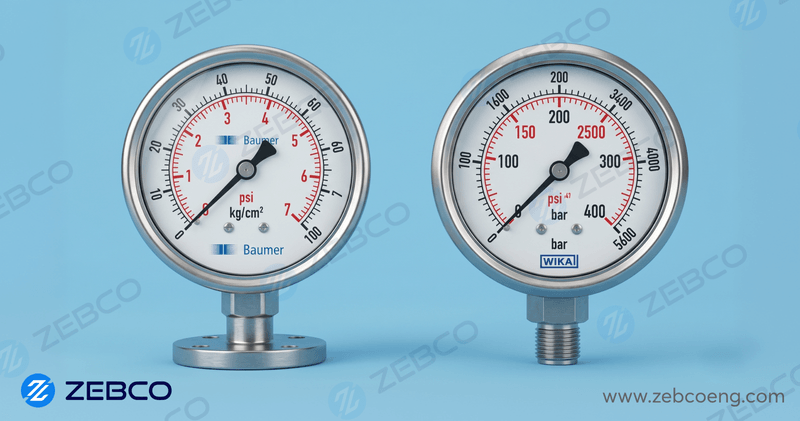
Pressure and vacuum measurement instruments are the eyes of a semiconductor plant. Every process step — from wet etch baths to CVD chambers — requires reliable, accurate, and contamination-free pressure indication.
How Pressure Gauges Work: The Bourdon Tube Principle
The overwhelming majority of mechanical pressure gauges in industrial use — including those used in semiconductor plants — operate on the Bourdon tube principle, patented by Eugène Bourdon in 1849. Here is how it works:
A curved, hollow metallic tube (typically C-shaped, spiral, or helical) is sealed at one end and connected to the process at the other. When pressure is applied, the tube tends to straighten proportionally to the applied pressure. This mechanical deflection is transmitted through a gear-and-pinion linkage to a pointer on the dial. The degree of pointer rotation directly indicates the process pressure.
C-Type Bourdon Tube
Most common design. Suitable for pressures from 0.6 bar to 1,000 bar. The curved tube opens under pressure, driving the pointer mechanism. Standard in WIKA 232.50 and Baumer AL series.
Spiral Bourdon Tube
Multiple turns increase sensitivity and accuracy. Used for lower pressure ranges where greater precision is needed. Common in differential and compound gauge applications in semiconductor wet benches.
Helical Bourdon Tube
High-accuracy design for precise applications. Used in calibration-grade gauges and high-pressure measurement above 600 bar. Found in specialty semiconductor process control instruments.
Types of Gauges for Semiconductor Applications
Gauge Pressure
0 to 600 bar
Measures pressure relative to atmosphere. Used for gas supply lines, CDA systems, N₂ headers.
Vacuum Gauge
-1 to 0 bar
Measures sub-atmospheric pressure. Critical for CVD, PVD, etch chambers, load locks.
Compound Gauge
-1 to +X bar
Measures both vacuum and positive pressure. Ideal for systems that cycle between positive and negative pressures.
Differential Gauge
ΔP measurement
Measures pressure difference across filters, membranes, or flow restrictors in gas panels.
Glycerin-Filled
Vibration damped
Glycerin dampens pointer oscillation in high-vibration environments like pump stations and mechanical rooms.
Dry Gauge
Cleanroom grade
No fill liquid. Required in cleanrooms where liquid contamination risk from glycerin is unacceptable.
Material Selection: SS304 vs SS316 vs SS316L
The choice of wetted material — the metal that comes into contact with the process medium — is critical in semiconductor environments. Here is a comparison:
| Property | SS 304 | SS 316 | SS 316L |
|---|---|---|---|
| Chromium Content | 18–20% | 16–18% | 16–18% |
| Molybdenum | None | 2–3% | 2–3% |
| Carbon Content | ≤0.08% | ≤0.08% | ≤0.03% (Low C) |
| Chloride Resistance | Moderate | Good | Excellent |
| Weld Sensitization Risk | High | Moderate | Minimal |
| UHP Compatibility | Not Recommended | Acceptable | Preferred |
| Semiconductor Application | Utility lines only | General process | All UHP gas systems |
| Electropolishing | Limited benefit | Effective | Standard requirement |
Accuracy Classes for Semiconductor Gauges
Gauge accuracy is expressed as a percentage of full-scale span, defined by standards such as EN 837 (Europe) and ASME B40.100 (USA). In semiconductor plants, higher accuracy classes are required for process-critical measurements:
Class 4.0
±4.0% FS
Utility monitoring. Non-critical pressure indication only.
Class 2.5
±2.5% FS
General industrial use. Acceptable for secondary lines.
Class 1.6
±1.6% FS
Process monitoring. Standard for most semiconductor utility applications.
Class 1.0
±1.0% FS
High-accuracy process gauges for gas panels and regulators.
Class 0.6
±0.6% FS
Precision measurement. Used on UHP gas manifolds and critical supply headers.
Class 0.25
±0.25% FS
Laboratory and calibration standard accuracy. Test and calibration references.
Baumer vs WIKA: Side-by-Side Comparison for Semiconductor Applications
| Parameter | WIKA | Baumer |
|---|---|---|
| Brand Origin | Germany (1946) | Switzerland (1952) |
| Best Accuracy | Class 0.25 (calibration) | Class 0.6 / ±0.3% (electronic) |
| Product Range | Extremely broad (10,000+ models) | Focused precision portfolio |
| UHP Wetted Parts | SS316L available | SS316L standard on AL series |
| Digital / Transmitter | WIKA S-20, PGT21 | Baumer MEX5 (IO-Link) |
| Semiconductor Reference | Global OEM specification | Preferred for precision panels |
| India Availability | Widely stocked | Specialist supply |
| Recommended For | Utility, chemical, gas supply lines | Gas panels, UHP precision monitoring |
Zebco Engineering Recommendation
For general semiconductor plant utility monitoring (CDA, N₂ bulk, cooling water, facility gas), WIKA 232.50 / 233.50 offers the best value and global compliance. For UHP gas panel monitoring, specialty gas cabinets, and high-accuracy process measurement, Baumer AL Series with SS316L wetted parts is the preferred specification. Zebco Engineering LLP supplies both brands with short lead times to semiconductor facilities across India.
UHP Gas Regulators: SMC, Fujikin,Carten & Tescom — Deep Technical Guide
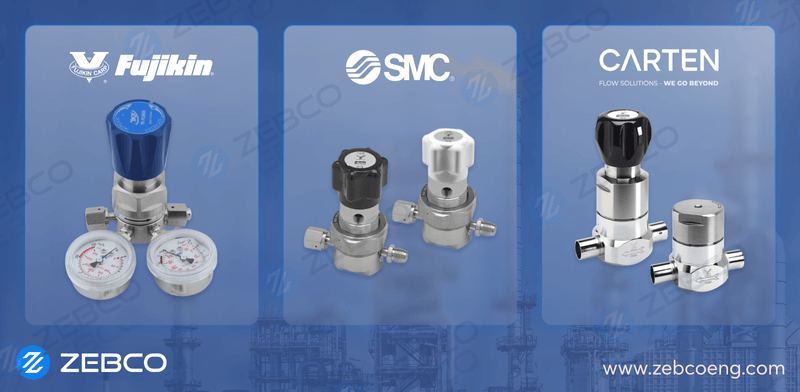
In semiconductor gas delivery, the regulator is the precision heart of the system. It maintains stable outlet pressure regardless of fluctuating inlet supply pressure or varying downstream demand — and in UHP environments, it does so without introducing a single contaminating particle or molecule.
Why SS316 / SS316L is the Only Choice for UHP Regulators
Semiconductor process gases include reactive, corrosive, and ultra-pure species. The regulator body, diaphragm, seat, and all wetted surfaces must resist corrosion, eliminate particle generation, and refuse to outgas hydrocarbons or moisture into the gas stream. SS316L achieves this through:
Molybdenum addition (2–3%) for superior chloride and acid resistance
Low carbon (≤0.03%) prevents carbide precipitation during welding
Electropolished interior surfaces reduce Ra to <0.25 µm, minimising particle traps
Passivated surfaces form a stable Cr₂O₃ oxide layer that resists chemical attack
High-purity melting practice (vacuum induction + vacuum arc remelting) minimises inclusions
Compatible with HF, HCl, Cl₂, NF₃, WF₆, BF₃, and other aggressive semiconductor gases
Single-Stage vs Dual-Stage Regulators
Single-Stage Regulator
Reduces gas pressure in one step. As the cylinder empties and inlet pressure drops, the outlet pressure tends to creep upward. Suitable for non-critical applications or where cylinder pressure is relatively stable, such as bulk supply. Simpler, lower cost, compact.
Semiconductor use: Secondary regulation, panel-mounted point-of-use control.
Dual-Stage Regulator
Two-stage pressure reduction provides near-constant outlet pressure regardless of inlet pressure variation. Critical when using pressurised cylinders that deplete from 200 bar to near zero. Superior pressure stability, virtually eliminates outlet creep. Required for specialty gas cylinders and research-grade applications.
Semiconductor use: All specialty gas cylinder regulators, UHP toxic gas cabinets, dopant gas delivery.
Parker & Swagelok SS316L Fittings:The Backbone of UHP Gas Distribution
In a semiconductor gas delivery system, fittings are everywhere — and every single one must be leak-free. A single improper fitting can contaminate a gas line, introduce a particle, or in the case of toxic or pyrophoric gases, create a catastrophic safety incident. Parker and Swagelok are the two global benchmarks.
Types of Fittings Used in Semiconductor Plants
Compression Fittings Swagelok / Parker A Lok
Two ferrule compression fittings that minimize the surface ID to create a leak tight seal. No threading, no welding required at point of installation. The most widely used fitting type for gas distribution tubing in UHP gas systems.
VCR Face Seal Fittings Swagelok / Parker
Metal gasket face seal fittings that provide the highest leak integrity of any mechanical fitting. Helium leak test performance to ultra high purity standards.
VCO O Ring Face Seal Swagelok
Elastomeric O ring face seal for applications where metal gasket is not required. Used in gas utilities and distribution where frequent disconnection is anticipated.
Double Ferrule System
Both Swagelok and Parker compression fittings use a patented double ferrule front and back design. This front ferrule provides the sealing action.
Weld Fittings & Orbital Welding
For permanent ultra pure connections in process gas distribution, orbital automated TIG welding of 316L tubing with matching weld fittings provides the ultimate leak integrity.
High Purity Tube Fittings
Electropolished 316L tube fittings with electropolished nuts, ferrules and bodies. Cleaned, bagged and certified for UHP service.
Why SS316 / SS316L Materials Are Non-Negotiable in Semiconductor Instrumentation
The specification of SS316L is not a preference — it is a fundamental requirement in semiconductor gas handling. Every wetted component that contacts a process gas must meet this standard. Here is the complete technical rationale.
Superior Corrosion Resistance
The 2-3% molybdenum addition in SS316L creates a significantly more stable passive film compared to 304 stainless. This makes 316L resistant to pitting, crevice corrosion, and stress corrosion cracking in the presence of chlorides, fluorides, and the full range of semiconductor process chemicals including HF, HCl, HBr, NF₃, WF₆, and Cl₂.
Chemical Compatibility
SS316L is compatible with the vast majority of semiconductor process gases including nitrogen, argon, hydrogen, ammonia, silane, chlorine, hydrogen chloride, boron trichloride, and many others. The low carbon content prevents chromium carbide sensitization that would otherwise compromise corrosion resistance in welded assemblies.
High-Purity Electropolishing Response
SS316L responds excellently to electropolishing. The electrochemical process removes the outermost metal layer to achieve surface roughness below Ra 0.25 µm. Smoother surfaces mean fewer particle-trapping sites, lower adsorption of moisture and hydrocarbons, and superior resistance to oxide scale buildup during passivation.
Minimal Metal Contamination Risk
Ultra-pure gas streams must contain near-zero ppb levels of metallic contamination. SS316L, properly electropolished and passivated, achieves extremely low metal extraction rates even when exposed to aggressive semiconductor process gases, protecting the wafer from potentially catastrophic metal contamination at nanoscale levels.
Weld Integrity for UHP Systems
The L designation, Low Carbon, in 316L is specifically required for welded UHP systems. High carbon SS316 can experience chromium carbide precipitation at grain boundaries during welding, compromising corrosion resistance. SS316L eliminates this risk, enabling the full penetration orbital welds required in semiconductor gas distribution piping.
Long-Term Fab Reliability
Semiconductor fabs are multi-billion dollar investments designed to operate 24/7 for decades. SS316L instrumentation components, properly specified, installed, and maintained, provide decades of reliable service without corrosion-induced failure, particle generation, or purity degradation. Total cost of ownership strongly favours SS316L over cheaper alternatives.
| SS316L Specification | Typical Value | Significance for Semiconductor |
|---|---|---|
| Carbon (C) | ≤0.03% | Prevents sensitization during welding, essential for orbital-welded gas piping |
| Chromium (Cr) | 16-18% | Forms protective Cr₂O₃ passive film, basis of corrosion resistance |
| Nickel (Ni) | 10-14% | Stabilizes austenitic structure, improves ductility and toughness |
| Molybdenum (Mo) | 2-3% | Critical for pitting resistance in halogen-containing process gases |
| Electropolished Ra | <0.25 µm | Minimizes particle-trapping surface topology, reduces adsorption sites |
| Passivation Layer | Cr₂O₃ 2-5 nm | Provides chemical barrier, reduces metal leaching into gas stream |
| Helium Leak Rate | <10⁻⁹ Pa·m³/s | UHP standard for all pressure-bearing components in gas panels |
India & Global Semiconductor Fab Plants:A Growing World of Precision Manufacturing
India is at the threshold of a semiconductor revolution. Government initiatives, global investment, and strategic partnerships are transforming the country into a credible manufacturing hub — creating massive demand for semiconductor-grade instrumentation and components.
India Semiconductor Opportunity
India’s semiconductor ambitions create a once-in-a-generation opportunity for domestic instrumentation suppliers. Every new fab, whether ATMP or front-end, requires thousands of pressure gauges, hundreds of UHP regulators, and tens of thousands of SS316L fittings. Companies that can reliably source, certify, and deliver these components to international quality standards are positioned to become long-term strategic suppliers to India’s semiconductor ecosystem.
How Zebco Engineering LLP Supports Semiconductor Instrumentation Procurement
Your Semiconductor Instrumentation Partner in Ahmedabad and Across India
Zebco Engineering LLP supplies industrial instrumentation and semiconductor-grade process components from WIKA, Baumer, SMC, Tescom, Swagelok, Fujikin, and Carton to fabs, ATMP facilities, specialty gas panels, chemical systems, and high-purity gas distribution networks across India.
ISO+
Certified instrumentation from globally trusted brands
SS316L
High-purity wetted parts for clean process applications
Fast
Sourcing and delivery support for urgent requirements
24/7
Application support for mission-critical process needs
What We Offer for Semiconductor Plants
Semiconductor Application Understanding
Our engineering team understands the unique requirements of semiconductor gas cabinets, cleanroom pressure monitoring, bulk gas headers, chemical supply lines, wet bench process environments, CDA panels, and high-purity stainless steel installations.
Brand and Product Selection Support
We help engineers select pressure gauges, regulators, fittings, valves, and transmitters based on gas compatibility, pressure range, wetted material, accuracy class, connection type, and cleanroom suitability.
Fast Sourcing for Project Timelines
Semiconductor projects operate on tight construction and tool installation schedules. We support procurement teams with fast availability checks, equivalent suggestions, and brand alternatives where timelines are critical.
Technical Documentation and Certification
We assist with material certificates, test reports, datasheets, PED, ATEX, ISO, and compliance documents wherever available. This helps project, quality, and vendor teams maintain documentation discipline for audits and approvals.
High Vacuum and Specialty Gas Supply Experience
Our experience includes gauge and regulator selection for inert gases, toxic gases, corrosive gases, vacuum lines, high-pressure cylinders, and stainless steel distribution systems used in advanced process environments.
Cleanroom Maintenance Supply
Beyond initial project supply, we support maintenance, replacement, shutdown, and emergency instrumentation requirements for fabs, ATMP plants, and high-purity manufacturing facilities.
Why Choose Zebco Engineering LLP for Your Semiconductor Instrumentation Needs
In a sector where the wrong fitting can cost crores in downtime and the wrong regulator can compromise months of wafer output, your instrumentation supplier must be more than a catalogue. They must be a technical partner.
Capability | What We Offer |
|---|---|
| Brand Portfolio | WIKA, Baumer, SMC, Fujikin, Carton, Tescom, Parker Hannifin, Swagelok — and more |
| Product Categories | Pressure gauges, vacuum gauges, compound gauges, UHP regulators, tube fittings, VCR fittings, instrumentation valves, diaphragm valves, pressure transmitters |
| Material Expertise | SS304, SS316, SS316L, Hastelloy C-22, Monel, PTFE, PCTFE — full material specification and certification support |
| Certifications Supported | EN 10204 3.1/3.2, Mill Test Certificates, ATEX, CE, PED, SEMI F57, calibration certificates, PMI reports |
| Customer Types | Semiconductor fabs, EPC contractors, OEM equipment manufacturers, pharma cleanrooms, petrochemical plants, defence and aerospace |
| Delivery Coverage | Pan-India with base in Ahmedabad, Gujarat — proximity to Micron Sanand, CG Power Renesas, and other Gujarat semiconductor facilities |
| Technical Support | Application engineering, product selection, drawing review, specification compliance, pre-shipment inspection coordination |
SS316 and SS316L have nearly identical chemical composition except for carbon content. SS316 allows up to 0.08% carbon, while SS316L (the "L" standing for low carbon) limits carbon to 0.03% maximum. In semiconductor applications, this matters primarily for two reasons. First, SS316L can be welded without risk of sensitisation — chromium carbide precipitation at grain boundaries that degrades corrosion resistance in the heat-affected zone. Second, SS316L meets SEMI F57 and most fab specifications for wetted parts in UHP gas systems. For any instrument or fitting that will be welded, purged with high-purity gas, or used in a UHP gas delivery application, SS316L is the mandatory specification.
A Bourdon tube is a curved hollow metallic tube, sealed at one end, that straightens proportionally when internal pressure is applied. This mechanical deformation is transmitted through a gear-and-pinion mechanism to drive a pointer on a calibrated dial. Bourdon tube gauges are used extensively in semiconductor plants for several reasons: they require no external power source (purely mechanical), they are reliable, well-understood, and available in SS316L wetted versions with high accuracy classes. They are the preferred choice for gas supply monitoring, facility systems, and secondary gas distribution lines where visual local indication is needed.
VCR (Vacuum Coupling Radiation) fittings are metal gasket face-seal fittings developed by Swagelok. A soft metal gasket (typically stainless steel, silver-plated, or nickel) is compressed between two highly polished face-seal surfaces when the coupling nut is tightened, creating a metal-to-metal seal. The critical advantage over compression or NPT fittings is leak performance — VCR fittings achieve helium leak rates below 4×10⁻¹⁰ std cm³/s, making them the global standard for connecting UHP components in semiconductor gas panels, valve manifold boxes (VMBs), and gas sticks. They are also highly re-usable (with gasket replacement) and leave a zero-dead-volume connection.
Electropolishing is an electrochemical process that removes the outermost layer of metal from a stainless steel surface by immersing it in an acid electrolyte and applying a DC current. The result is a surface with roughness (Ra) below 0.25 µm — significantly smoother than mechanical polishing alone. For semiconductor instrumentation, electropolishing is required because smoother surfaces have fewer microscopic valleys and peaks where particles can be trapped and later released into the gas stream. Electropolished surfaces also have superior chemical resistance, lower moisture adsorption, and better passivation response. All UHP-grade regulators, fittings, and gas panels specify electropolished interiors.
A single-stage regulator reduces supply pressure to delivery pressure in one step. As the gas cylinder depletes and inlet pressure drops, the outlet pressure tends to rise (outlet pressure rise phenomenon) — this can affect process stability. A dual-stage regulator performs two sequential pressure reductions. The first stage reduces the high cylinder pressure to an intermediate level; the second stage provides the final, stable delivery pressure. The result is dramatically better outlet pressure stability as cylinder pressure varies from full to empty. In semiconductor applications, dual-stage regulators are specified for all cylinder-gas services, toxic gas cabinets, and any application requiring consistent delivery pressure regardless of supply pressure variation.
Fujikin has built its reputation through decades of exclusive focus on ultra-high purity fluid control for the semiconductor industry. Several factors make them the top specification: their manufacturing environment is itself a semiconductor-grade cleanroom; their components meet or exceed SEMI F78, SEMI S2, and customer-specific requirements from TSMC, Samsung, Intel, and Micron; their FSSR series regulators feature all-welded SS316L bodies with Ra below 0.2 µm and helium leak rates below 1×10⁻¹⁰ Pa·m³/s; and they provide full traceability documentation including cleanliness certificates verified by SEM/TEM analysis. No other manufacturer combines this level of purity assurance, mechanical precision, and industry-specific product development in a single package.
The accuracy class depends on the application criticality. For UHP gas panel monitoring and critical process gas supply lines, a minimum of Class 1.0 (±1.0% full scale) is recommended, with Class 0.6 preferred for precision gas delivery monitoring. For general utility systems (CDA, bulk N₂, facility cooling water), Class 1.6 or Class 2.5 is typically acceptable. Class 0.25 is reserved for calibration reference standards. Remember that accuracy class is defined at reference conditions (typically 20°C ambient); actual in-service accuracy must also account for temperature effects, vibration, and media compatibility. For critical applications, WIKA and Baumer both offer gauges with thermal compensation to maintain accuracy across a wider temperature range.
Yes — Parker A-Lok (CPI series) compression fittings are designed to be dimensionally interchangeable with Swagelok fittings. They use the same double-ferrule design, same nut and body dimensions, and the same tube OD sizes. Parker explicitly rates their fittings as interchangeable with Swagelok. However, VCR-style face seal fittings should be checked carefully — not all brands' VCR-style fittings are dimensionally identical, and mixing incompatible face-seal fittings could compromise leak integrity. For VCR connections, it is best practice to use components from the same manufacturer throughout a given gas stick or panel assembly. Always consult your brand technical representative or Zebco Engineering's team for specific compatibility guidance before mixing brands in a critical UHP system.
Micron's Sanand ATMP facility, while primarily an assembly and test plant rather than a front-end wafer fab, still requires extensive semiconductor-grade instrumentation. This includes: pressure gauges (WIKA or Baumer type) for CDA, N₂, DI water, and chemical monitoring throughout the facility; UHP regulators (SMC, Fujikin, or equivalent) for process gas delivery in bonding, encapsulation, and test areas; SS316L tube fittings and VCR fittings for gas panel construction; pressure transmitters and flow meters for automated process control systems; cleanroom-compatible instruments with particle-free enclosures; and vacuum gauges for any process chambers or material handling systems. As one of Ahmedabad's largest cleanroom facilities, Micron represents a major ongoing demand for precision instrumentation procurement — a market Zebco Engineering actively serves.
SEMI F57 is the industry standard that specifies material purity requirements for components used in bulk gas and chemical distribution systems in semiconductor manufacturing. It defines acceptable metallic impurity levels in elastomers, polymers, and metallic materials used for wetted parts — providing a verifiable benchmark that suppliers must meet for their materials to be accepted in a semiconductor fab. When procuring SS316L fittings, regulators, gauges, or valves for semiconductor service, SEMI F57 compliance is often a mandatory procurement requirement. Zebco Engineering can provide products with SEMI F57-compliant material certifications and can assist your quality team in reviewing and approving material documentation packages.
Glycerin-filled gauges use liquid glycerin (glycerol) to dampen pointer oscillation caused by pulsation or vibration. In cleanroom environments, there are two concerns. First, glycerin can leak from the gauge case or window due to thermal expansion cycles, temperature extremes, or seal degradation — and any liquid contamination inside a cleanroom is unacceptable from a particle and organic contamination standpoint. Second, certain semiconductor process gases (such as pure oxygen or strong oxidisers) require completely oil-free and liquid-free instrumentation to prevent fire, explosion, or catalytic decomposition hazards. For cleanroom and gas service applications, dry gauges are always specified. For vibration-prone utility environments outside the cleanroom, glycerin filling remains acceptable.
A compound gauge measures both positive pressure (above atmospheric) and vacuum (below atmospheric) on a single dial. The scale typically reads from -1 bar (full vacuum) through 0 to a specified positive range, such as +3, +5, or +10 bar. In semiconductor plants, compound gauges are used where a system alternates between positive and vacuum conditions — for example, load lock chambers that are evacuated and then back-filled with inert gas, chemical delivery systems that use vacuum-assisted transfer followed by positive pressure purge, or vacuum chuck systems on wafer handlers. A compound gauge eliminates the need for separate vacuum and pressure instruments in these dual-phase applications.
The standard industry rule is to select a gauge with a full-scale range approximately 1.5 to 2 times the normal operating pressure. This keeps the pointer in the middle third of the dial during normal operation — the range where Bourdon tube accuracy is best — and provides adequate margin for pressure surges without over-ranging and permanently damaging the tube. For example, if your N₂ supply line operates at 7 bar, select a 0–16 bar gauge. If your CDA operates at 8 bar, select a 0–16 bar gauge. For static (non-pulsating) services, a ratio of 2:1 is fine. For pulsating service, consider a liquid-filled gauge or an overpressure protector, and use a 3:1 ratio to extend gauge life. Never operate a gauge above 75% of its full-scale range continuously.
Semiconductor fab projects typically require a comprehensive documentation package for each instrument or component. This commonly includes: EN 10204 3.1 Mill Test Certificate (MTC) for all SS316L material — confirming chemical composition and mechanical properties with works certified signatory; Calibration Certificate with traceability to national standards (NABL accredited for India); Positive Material Identification (PMI) report for critical pressure-bearing parts; Helium Leak Test Certificate for UHP regulators and fittings; SEMI F57 material compliance declaration; Dimensional inspection report; Cleanliness verification certificate (particularly for UHP components from Fujikin or Swagelok UHQ); and in some cases, a Certificate of Conformance (CoC) signed by the manufacturer. Zebco Engineering can coordinate, collect, and compile the complete documentation package for your project.
A mechanical pressure gauge provides local visual indication only — the reading is only available to someone physically standing at the instrument. A pressure transmitter (such as the Baumer MEX5) converts pressure into an electrical signal (typically 4–20 mA, HART, or IO-Link) that can be transmitted to a DCS, SCADA, or PLC for remote monitoring, alarming, and automated control. In semiconductor plants, both are used: gauges are installed at local monitoring points on gas panels, chemical delivery systems, and utility headers for field operator reference; transmitters are used wherever automated control, remote indication, data logging, or integration with the fab manufacturing execution system (MES) is required. Critical UHP gas delivery systems typically use both — transmitters for automation and gauges as an independent local check.
Yes. While our base is in Ahmedabad, Gujarat — with excellent proximity to Micron's Sanand facility and the CG Power + Renesas project — we supply semiconductor instrumentation to projects and facilities across India. This includes EPC contractors working on semiconductor projects in Karnataka (ISMC, Kaynes), Assam (Tata Semiconductor), and other states where India's semiconductor ecosystem is developing. We partner with established logistics providers for time-critical delivery and can arrange pre-shipment inspection, export documentation, and factory acceptance testing coordination for imports. Contact our team to discuss your project location and requirements.
The WIKA 233.50 is a fully stainless steel Bourdon tube pressure gauge — unlike the 232.50 which uses a copper alloy Bourdon tube and brass internals by default. The 233.50 features an SS316L Bourdon tube, SS316 socket, and SS304 case, making every component that contacts the process medium resistant to the acid, solvent, and oxidiser environments found in semiconductor wet process areas. Specifically, it is suitable for HF/HNO₃ (RCA-1 clean), H₂SO₄/H₂O₂ (SPM clean), NH₄OH/H₂O₂/H₂O (SC-1), and similar aggressive chemistries. The model is also available with glycerin fill (for vibration resistance near pump stations) or dry (for cleanroom installation), and with various process connections from G1/4 to G1/2. It is the standard WIKA recommendation for chemical delivery and exhaust systems in semiconductor fab wet decks.
Pressure regulation directly impacts semiconductor yield through several mechanisms. In CVD (chemical vapour deposition) processes, the chamber pressure controls the mean free path of gas molecules, deposition rate, film stoichiometry, and step coverage — even small pressure fluctuations produce measurable variation in film thickness and composition that translates directly to device performance spread and yield loss. In ALD (atomic layer deposition), cycle-to-cycle pressure precision determines monolayer growth rate and interface abruptness at the sub-nanometre scale. In plasma etch, chamber pressure controls ion energy and etch rate uniformity across the wafer. In all these applications, a precision dual-stage UHP regulator that maintains ±0.1% delivery pressure stability — such as the Fujikin FSSR or SMC NR series — is not a luxury; it is a fundamental requirement for consistent, high-yield wafer fabrication.
SMC and Fujikin serve somewhat different (though overlapping) roles in semiconductor gas delivery. Fujikin's primary focus is ultra-high purity, ultra-low contamination components for the most critical process gas streams — specialty gases, dopants, and toxic gas delivery where the absolute highest purity and documentation standards are mandatory. Fujikin is the preferred specification at leading-edge fabs for these applications. SMC, as the world's largest pneumatics manufacturer, offers a much broader product range including pneumatic actuators, solenoid valves, fittings, and MFCs alongside their UHP gas components. SMC is widely used for gas panel automation (pneumatically-actuated diaphragm valves), point-of-use pressure control, and applications where their broader system integration capability is valuable. Many gas panels and VMBs use Fujikin manually-operated valves and regulators together with SMC-actuated automated valves — the brands complement rather than compete with each other in the complete gas delivery system.
Contact Zebco Engineering LLP directly through our website at zebcoeng.com or email us at info@zebcoeng.com. When reaching out, it helps to share: the application description (process gas type, pressure range, temperature, flow rate); the brand preference or specification document reference; the required quantity and delivery timeline; any documentation requirements (MTC, calibration, SEMI compliance); and your project location in India. Our engineering team will respond with a technical product recommendation, datasheet, and quotation. For complex project requirements — such as a full gauge package, a regulator assembly, or a fitting hardware kit for a new fab construction project — we offer a dedicated project consultation to ensure everything is correctly specified, certified, and delivered on time.


